Rep. Van Epps Questions DOE Secretary Wright on Drone Threat to Electric Grid
Rep. Van Epps Questions DOE Secretary Wright on Drone Threat to Electric Grid
Rep. Van Epps (TN-07) participated in a Science, Space, and Technology Committee hearing reviewing the FY27 Budget Request for the Department of Energy (DOE).
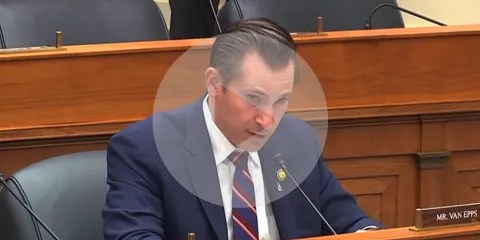
Watch Rep. Van Epps' statement here.
Read Rep. Van Epps’ opening remarks here:
“Thank you, Mr. Chairman, and thank you, Secretary Wright, for your testimony. Under the Biden administration, American energy was crippled by “green” policies, ESG requirements, and progressive special-interest groups. Coal, natural gas, and hydro-powered electricity plants were at risk of closure, tracking us toward a massive energy shortfall. This anti-growth mindset prevented us from harnessing America’s abundance, leading to energy scarcity and rendering us dependent on foreign nations for energy.
Under the Trump administration, and Secretary Wright’s leadership, we have reversed course. The DOE has taken decisive action to initiate an American Nuclear Renaissance. We are reshoring American-made supply chains for critical minerals, aligning energy policy with U.S. national security, and reducing U.S. dependence on foreign supply chains. Instead of shuffling taxpayer dollars toward unreliable, intermittent energy projects, this administration is prioritizing the protection of our energy infrastructure as we face sustained cybersecurity threats from foreign adversaries like China and Iran.
The President’s FY27 budget request establishes these priorities and secures the golden era of energy dominance by ensuring access to abundant, reliable, and affordable energy.”
Read Rep. Van Epps’ questions here:
Rep. Van Epps asked, “Secretary Wright, as you know, our critical infrastructure faces mounting threats, including our energy systems. According to a recent North American Electric Reliability Corporation [NREC] report, power grid asset owners and operators have expressed growing concerns around unmanned aircraft systems attacks. Last year, the Nuclear Regulatory Commission noted that nuclear power plant security forces lack authority to interdict or shoot down drones.
I introduced a bill yesterday to authorize critical infrastructure operators to detect, track, and neutralize unauthorized drones operating over protected sites. The bill gives the Secretary of Homeland Security, in consultation with the Secretary of Energy, the ability to determine which critical infrastructure facilities need these authorities
Secretary, what work is DOE’s Office of Cybersecurity, Energy Security, and Emergency Response doing to protect energy systems from drone threats, and to what extent would providing commercial energy system operators authorization to neutralize unauthorized drone threats support DOE’s ongoing work in this area?”
Secretary of the Department of Energy Christopher Wright replied, “...Representative, you raise a key issue. Drones are just massively expanding around the world for many applications, but as a threat to our energy infrastructure—absolutely true. Drones fly over our national labs; they fly over critical energy infrastructure. Absolutely, it's a real issue, and we are working across the agency, with the National Security Administration, with…[the] Department of the Interior about how we address… this threat…I love your engagement in it, and your passionate knowledge about it. So we definitely want to work with you and across the agencies about…[how]... we're going to change our policies…[and] how are we going to stop this growing threat…”
Rep. Van Epps asked, “Thank you, sir. I was glad to see that the DOE reorganization result[ed] in the creation of the Office of Critical Minerals and Energy Innovation, which you talked about a little bit earlier. Critical minerals and rare earth support key technologies such as EV batteries, semiconductors, and rare earth magnets. Secretary, can you expound on…the ongoing work the department's Office of Critical Minerals and Energy Innovation is doing to advance our domestic minerals processing capabilities, and what are the primary roadblocks to building back our domestic minerals processing capabilities?”
Sec. Wright responded, “...[W]e just exported so much of this expertise and equipment; we just haven't opened many mines in the U.S. in a long time. We have mining technology. The leading mining companies often are American. They mine all over the world, so we have the know-how, but we need to bring that supply chain, that equipment, and that trained personnel back into the United States to get these mines going. We're working with others to reopen existing mines.... We have one rare earth element mine in the United States for a long time out in California, it mines the ore and it sends it to China, and they process it there. So we are working with that as well to develop the processing of that in the United States. Mine that ore here, process it here, turn it into magnets, fabrication, and manufacturing here. We've got a lot of private sector partners in this as well. There's a lot of private capital flowing into this space, but it's because we are willing to make different decisions. We're willing to do… things like setting price floors that will give businesses the economic incentive to reshore these industries to our country…”